
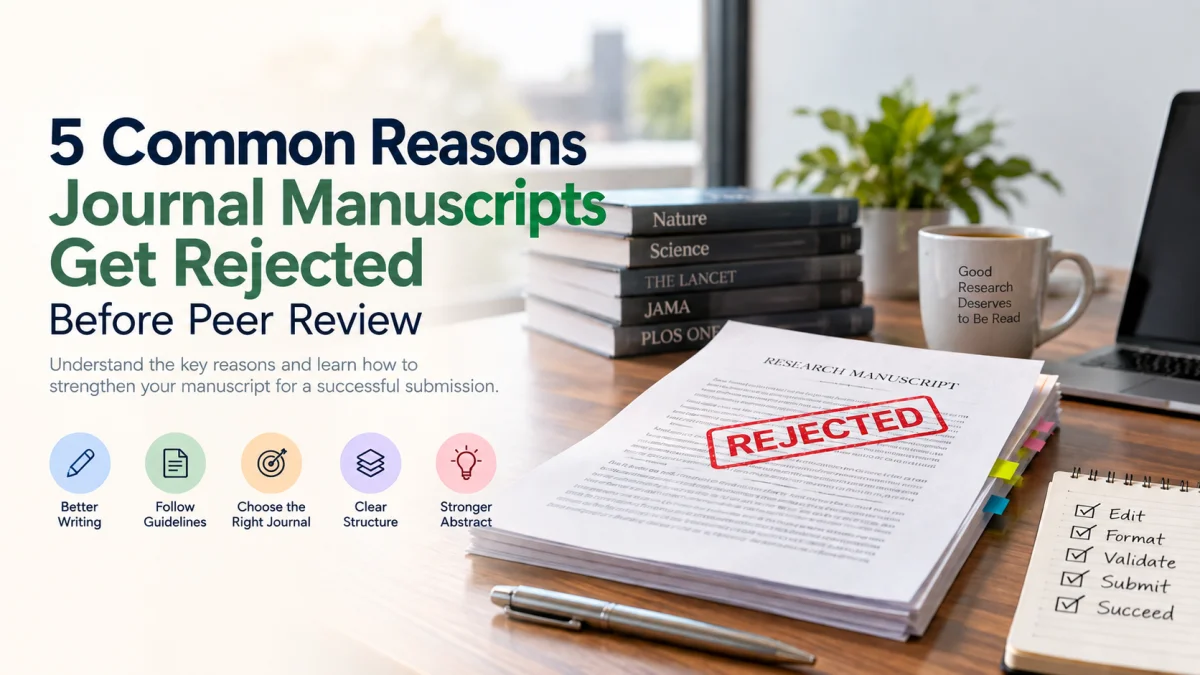
Submitting a research manuscript to an academic journal is a significant step in the publication journey. After months—or even years—of research, authors naturally expect their work to proceed to peer review. However, many manuscripts are rejected before they ever reach external reviewers. This initial editorial decision is known as a desk rejection.
Although some desk rejections are based on factors such as the journal's scope or research novelty, many are caused by issues that authors can prevent before submission. Language problems, formatting inconsistencies, weak abstracts, and incomplete submission requirements are among the most common reasons editors return manuscripts.
In this article, we explore five common reasons journal manuscripts are rejected before peer review and share practical tips to help authors improve their chances of a successful submission.
What Is a Desk Rejection?
A desk rejection is an editorial decision made before a manuscript is sent for peer review. During the initial screening, the journal editor evaluates whether the submission aligns with the journal's scope, quality standards, and technical requirements. If the manuscript does not meet these expectations, it may be rejected without being reviewed by subject experts.
A manuscript may receive a desk rejection due to:
- Language and readability issues.
- Poorly written or incomplete abstract.
- Failure to follow journal author guidelines.
- Weak manuscript organization or presentation.
- A poor fit with the journal's aims and scope.
The good news is that many of these issues are entirely avoidable with careful preparation before submission.
1. Poor Language and Grammar
Clear, professional language is essential for communicating research effectively. Editors expect manuscripts to be written in fluent academic English so that reviewers can focus on the research rather than the writing. Frequent grammar mistakes, awkward sentence construction, inconsistent verb tenses, punctuation errors, and overly complex paragraphs can make a manuscript difficult to read and may create a poor first impression.
Even strong research can appear less credible if the writing lacks clarity or consistency.
How to avoid it
- Review your manuscript for grammar, spelling, and punctuation.
- Improve sentence clarity and logical flow between paragraphs.
- Ensure consistent academic tone and terminology throughout the manuscript.
Consider professional language editing before submission, especially if English is not your first language.
2. The Manuscript Doesn't Match the Journal's Scope
A well-written manuscript can still be rejected if it is submitted to a journal that does not publish research in that subject area. Editors first determine whether the manuscript fits the journal's aims, readership, and research priorities before investing time in peer review.
Submitting to an unsuitable journal often results in an immediate desk rejection, regardless of the quality of the research.
How to avoid it
a. Read the journal's Aims and Scope carefully.
b. Review recently published articles to understand the journal's focus.
c. Check whether your research topic, methodology, and audience align with the journal.
Select a journal that matches your manuscript's objectives rather than choosing only by impact factor.
3. Failure to Follow Journal Author Guidelines
Every journal has detailed Author Guidelines that specify how manuscripts should be prepared and submitted. These instructions cover formatting, structure, references, figures, tables, word limits, and required submission documents. Ignoring these requirements is one of the most common reasons manuscripts are returned for technical corrections or desk rejected.
Editors expect submissions to be publication-ready and compliant with the journal's technical requirements.
Common issues include
- Using the wrong manuscript template or formatting style.
- Exceeding abstract or manuscript word limits.
- Incorrect heading hierarchy or section order.
- Inconsistent reference formatting.
- Missing declarations, acknowledgements, funding statements, or author contributions.
Figures and tables that do not meet the journal's specifications.
How to avoid it
Before submitting, carefully review the journal's latest author guidelines, use the recommended template where available, verify formatting for references, headings, figures, and tables, and ensure all required submission documents are included.
4. Weak or Unclear Abstract
The abstract is often the first section an editor reads, and it plays a crucial role in the initial screening process. A weak abstract may fail to communicate the importance of the research, making it difficult for editors to understand the manuscript's contribution.
Common problems include providing too much background, presenting vague objectives, omitting key results, or exceeding the journal's word limit.
How to avoid it
Write an abstract that clearly explains:
- The research problem or background.
- The study objective.
- The methodology used.
- The key findings.
The main conclusion and significance of the study.
A concise, well-structured abstract gives editors confidence that the manuscript is worth sending for peer review.
5. Poor Manuscript Structure
A research manuscript should present information in a logical and consistent order. Even when the research is valuable, poor organization can make it difficult for editors and reviewers to follow the study.
Common structural issues include unclear section flow, repetitive content, weak transitions between paragraphs, inconsistent headings, undefined abbreviations, and misplaced figures or tables.
How to avoid it
- Follow the journal's recommended manuscript structure.
- Ensure each section has a clear purpose and logical progression.
- Maintain consistency in headings, terminology, and formatting.
Review the overall flow to ensure the manuscript is easy to read from introduction to conclusion.
A well-organized manuscript improves readability and creates a stronger first impression during editorial screening.
Final Thoughts
A desk rejection does not always reflect the quality of your research. In many cases, it results from avoidable issues related to language, formatting, presentation, or journal selection. Taking time to refine your manuscript before submission can significantly improve its professionalism and readiness for editorial review.
Before submitting your next manuscript, ensure it is written clearly, formatted according to journal guidelines, supported by a strong abstract, organized logically, and aligned with the target journal's scope. These simple steps can help reduce avoidable desk rejections and improve your submission experience.
Frequently Asked Questions
Is language editing the same as proofreading?
No. Language editing improves grammar, clarity, sentence structure, and readability, while proofreading focuses on correcting minor errors before final submission.
Can formatting mistakes lead to desk rejection?
Yes. Many journals return manuscripts that don't follow author guidelines for references, figures, tables, headings, or document structure.
Do all journals require a cover letter?
No, but many international journals request one during manuscript submission.
Should I edit my manuscript before selecting a journal?
Yes. A well-edited manuscript makes it easier to evaluate journal suitability and adapt formatting later.
Need Help Preparing Your Manuscript?
editick provides professional editing and publication support for:
Research manuscripts
Theses and dissertations
Books and book chapters
Business and professional documents
Reference and manuscript formatting
From language editing to publication-ready formatting, editick helps you submit your work with clarity and confidence. For more details, visit www.editick.in